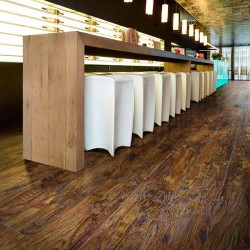
 A delightful place to meet and dine with friends and family, kitchens are fast becoming the heart of our home. Whether you’re just cooking or living and dining in this room, you need to consider wood floors that are both aesthetically pleasing and durable. In addition to design selection, laminate flooring that is moisture resistant, stain resistant and easy to maintain will be important selection criteria.
Is laminate flooring in the kitchen a good idea?
Yes, when properly cared for, real laminate flooring is an ideal choice for the kitchen. The kitchen is considered a semi-humid space and it is well known that humidity and wood are not a good combination. However, with a little care and attention, stylish, natural wood floors can be seamlessly applied to kitchens.
Advantages of laminate flooring in the kitchen
Offering a timeless look, laminate flooring is a natural product that brings warmth and elegance to any room in your home, including the kitchen. Laminate is warm underfoot, especially compared to the hardness of ceramic, which makes it more comfortable to walk. And you have the option of installing underfloor heating. Tarkett parquet is self-regulating compatible with underfloor heating systems up to a maximum temperature of 25˚C. Laminate flooring is incredibly durable. The thick and solid construction of laminated boards is easy to sand and straighten when they begin to show signs of wear. Oak in particular is a popular choice for its beauty and durability. A durable coating will allow easy cleaning of spills on the kitchen floor.
Related Post: We recommend that you also read the rubber floor covering article on the subject.
Parquet in the kitchen: which tree?
For many people, the kitchen is the heart of the home and will be the room with the highest traffic. That’s why when deciding which type of laminate to use in the kitchen, you need to consider laminate that is both aesthetically pleasing and durable – moisture resistant, stain resistant and easy to maintain. Although there are many different types of wood, some will be better at handling kitchen conditions than others. In general, you should avoid softwoods such as pine because they are less dense and more prone to moisture absorption. Instead, you should look for hardwoods such as oak, walnut, ash, birch, and maple.
Oak is perhaps the most popular wood for floors. Beautiful, noble and hard oak has ideal properties for flooring material. It offers a variety of temperaments depending on which part of the oak is used and how the floor is made. Options range from calm, noble plates consisting of a single tone to bolder colors that combine light and dark colors.
In addition to the type of wood, surface protection will affect the life and maintenance level of your laminate floor. A polished floor will be the most resistant to wear and tear and will be the easiest to maintain. A light white floor with a deep brushing effect adds shine to the kitchen, but requires more cleaning.
To inspire you and help you find the right laminate floor for every room in your home, we have carefully divided our product range into nine separate collections: Elegance, Heritage, Noble, Play, Prestige, Pure, Shade, Vintage and Viva. As you browse our beautiful laminated flooring collections, you’ll find a huge selection of oak and unique designs, patterns, colors and finishes to suit both your design style and lifestyle.
Our Viva collection, for example, offers a range of beautiful, practical and durable laminated floors with a design-oriented approach. It offers a range of laminate options that are incredibly easy to apply and are perfect for kitchens.
Can I use laminate flooring in the kitchen?
Yes, you can use wooden floors in the kitchen, and both laminated and solid wood floors are suitable.
Solid wood flooring is made from a single piece of hardwood, while laminated wood flooring is made from several layers of solid wood. At Tarkett, our wood laminated flooring features a top layer of hard and high-quality real wood in a variety of types and designs, including painting and heat treatment, and a transition plate middle layer, a balancing layer that stabilizes the plate and guarantees dimensional stability.
On the other hand, parquet has a dimensionally stable base that does not expand and contract to the same extent as solid hardwood flooring. Better than solid hardwood at dealing with changes in temperature and humidity, laminate flooring is particularly suitable for use in kitchens.
 Flooring Systems